

Gangway Installation: Every Type, Installed to Spec
The gangway is the most-used part of any floating dock
Every person who sets foot on a floating dock, marina slip, or fishing pier crosses the gangway first — and it's the one component that has to keep working while the water underneath it rises and falls. A gangway that's too short gets dangerously steep at low water. One with the wrong hinge or roller detail binds, twists, and tears itself apart. Jordan Marine Construction supplies and installs every type of gangway — residential and commercial, aluminum, steel, and timber — and we install each one to the manufacturer's specification and the site's engineering requirements.
Gangway types we provide
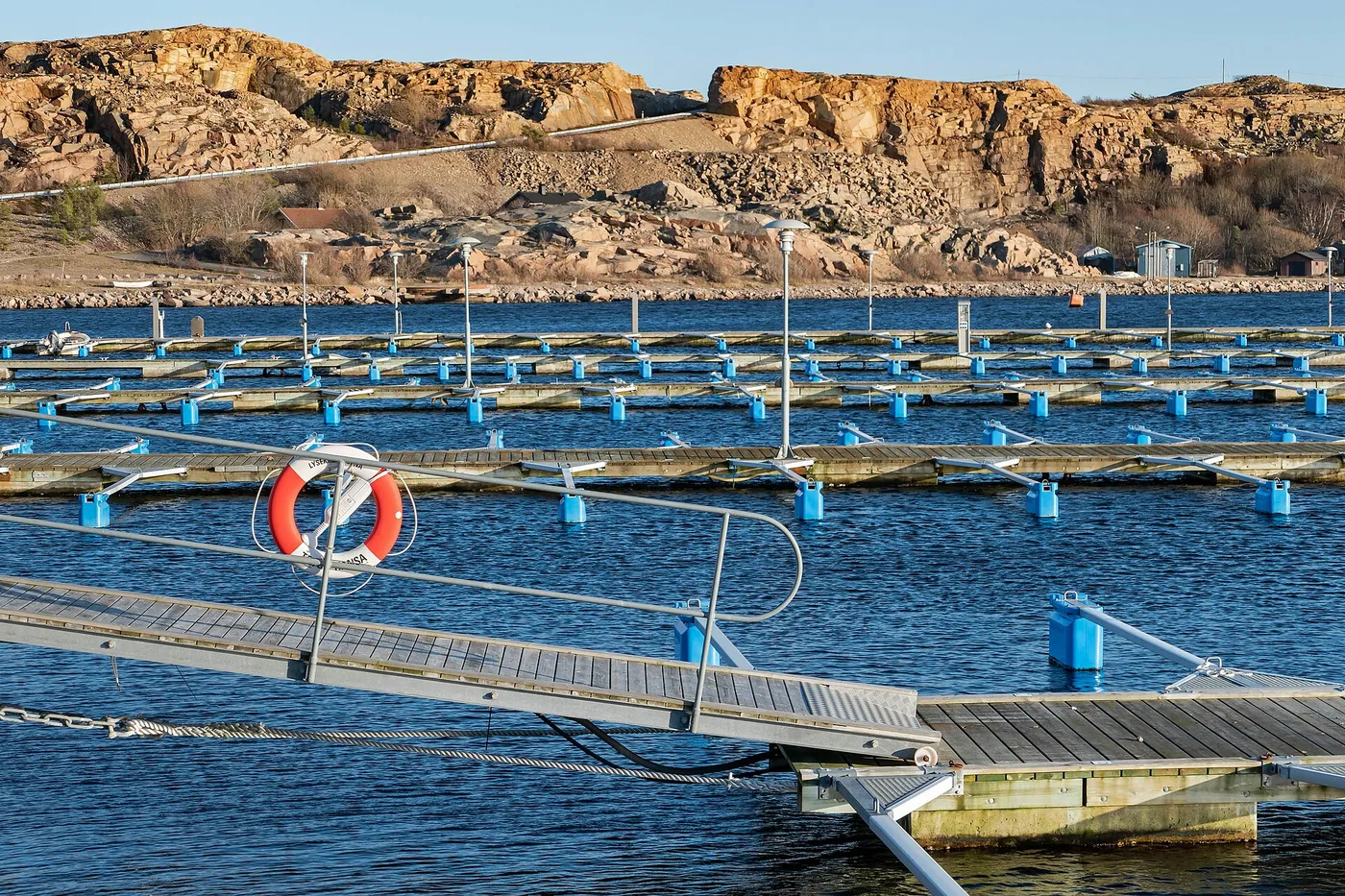
- Aluminum truss and pan gangways — the workhorse for floating docks and marinas. Lightweight, corrosion-resistant, available in standard lengths from 3' walkway sections up to 80'+ commercial spans, with welded handrails and slip-resistant decking.
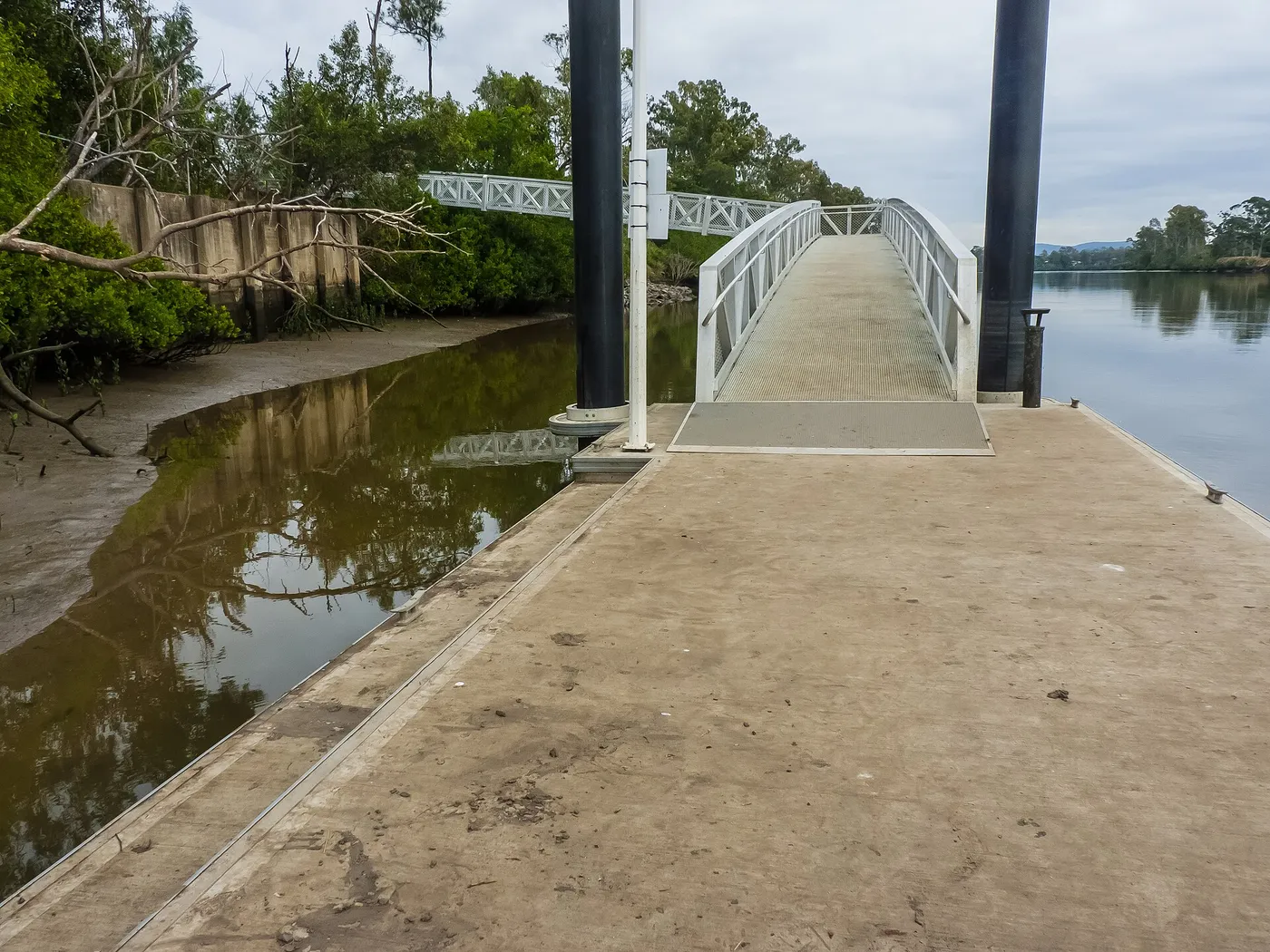
- ADA-compliant access gangways — longer spans and gentler slopes so the ramp stays accessible across the water-level range, with continuous handrails, edge protection, and transition plates at both ends.
- Steel gangways — for heavy commercial and industrial applications where cart, equipment, or high pedestrian loads govern the design.
- Timber gangways and shore transitions — custom-fabricated in-house from marine-grade treated lumber (2.5 CCA for saltwater, .60 for freshwater) to match an existing dock or boardwalk, like the shore approaches we build on our public pier projects.
- Articulating / hinged ramps — the shore-end hinge and float-end roller systems that let a fixed structure serve a floating one without stressing either.
Manufacturers we work with
We're not tied to one catalog. We select the gangway manufacturer whose product genuinely fits your dock system, water range, and budget — and when a stock unit isn't right, we have custom aluminum gangways fabricated to the engineered dimensions or build timber ones ourselves. Manufacturers we regularly specify include:
- Gator Dock & Marine — welded aluminum gangways and pedestrian bridges, including large-span commercial and ADA units.
- Ravens Marine — aluminum gangways, ramps, and custom marine fabrication.
- EZ Dock — polyethylene floating dock systems with matched gangway and ramp components.
- ShoreMaster — residential ramps and gangways for lake dock systems.
- AccuDock — aluminum-framed floating docks and gangways, including ADA configurations.
- Bellingham Marine — full-scale marina systems and commercial marina gangways.
Because we install across Lake Conroe, Lake Livingston, Lake Houston, Clear Lake, and the Texas Gulf Coast, we also know which products hold up in which environment — saltwater hardware packages, UV-rated decking, and float compatibility included.
What "installed to spec" actually means
A gangway is a small structure with real engineering behind it. Installing to spec means every one of these is checked against the manufacturer's documentation and the site conditions — not eyeballed:
- Length sized to the water range. We size gangway length from the full water-level fluctuation at your site, so the slope stays safe (and for accessible routes, as close to 1:12 as the range allows) at both extremes — not just on the day of installation.
- Load rating confirmed. Pedestrian live load (commonly 40–100 psf depending on application), point loads for carts or equipment, and railing loads are matched to the manufacturer's rated capacity with the engineer's safety factor.
- Shore-end connection engineered. The hinge or mounting bracket anchors to something that can take the load — a concrete abutment, bulkhead cap, or driven pilings — with the hinge axis level so the gangway tracks straight through its travel.
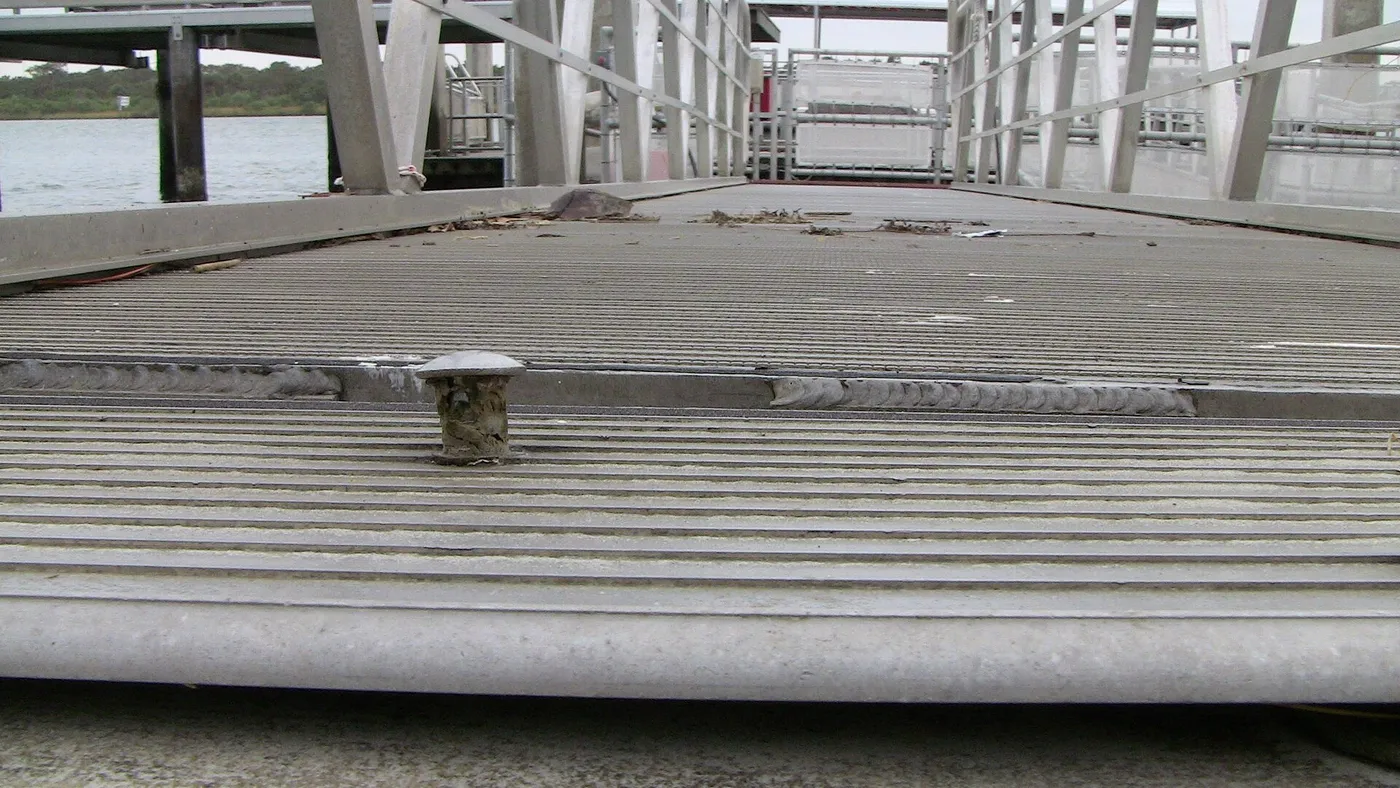
- Float-end detail that moves freely. Rollers, slide plates, or UHMW wear pads on a reinforced landing area, so the gangway end travels across the dock as the water moves instead of gouging the decking or hanging up.
- Transition plates at both ends. Smooth, gap-free walking surfaces on and off the gangway at every water level.
- Marine-grade hardware throughout. Hot-dip galvanized or stainless fasteners matched to the environment — stainless in saltwater, and isolation between dissimilar metals so aluminum isn't sacrificed to corrosion.
- Handrails and edge protection per code. Graspable rails at compliant heights, with kick plates or edge protection where the application calls for them.
Permitting and site work handled in-house
Like everything we build, gangway projects run through one accountable team. We coordinate permitting with the controlling authority — the SJRA on Lake Conroe, the City of Houston on Lake Houston, and the USACE Galveston District and Texas GLO on the coast — and we handle the site work a proper installation needs: abutments, pilings, bulkhead attachments, and reinforced landing areas on the float side.
Installation checklist
- Gangway length verified against the full seasonal water-level range.
- Manufacturer load rating matches the engineered design loads.
- Shore hinge anchored to abutment, bulkhead, or pilings — axis level.
- Float-end rollers/wear pads travel freely across a reinforced landing.
- Transition plates smooth at both ends, at every water level.
- Stainless or hot-dip galvanized hardware, dissimilar metals isolated.
- Handrails, edge protection, and slip-resistant decking verified.
- Full-travel test through the expected water range before handoff.
Sources & References
Note: We are not sponsored by or affiliated with any manufacturer listed. We specify whichever product best fits each project.
- Gator Dock & Marine — Aluminum Gangways & Pedestrian Bridges
- Ravens Marine — Aluminum Gangways & Ramps
- EZ Dock — Floating Dock Systems & Gangways
- ShoreMaster — Ramps & Gangways
- AccuDock — Floating Docks & ADA Gangways
- Bellingham Marine — Commercial Marina Systems
- U.S. Access Board — ADA Guide: Boating Facilities (gangway slope & access requirements)
Photos on this page are license-free reference images (CC0 public-domain dedication or U.S. government public domain) via Wikimedia Commons, credited in each caption. They illustrate gangway types and details, not our own projects.