

Riprap — graded armor stone placed along a shoreline — is a durable, natural-looking way to absorb wave energy and stop erosion. Jordan Marine Construction designs and installs riprap shoreline protection across Greater Houston, Lake Conroe, Lake Livingston, and the Texas Gulf Coast.
Riprap works especially well on gently sloped shorelines and as a complement to bulkheads and retaining walls. We size the stone and build the underlying filter layer correctly so the armor stays put and protects the bank for decades.
Request Your Free EstimateOur Riprap Installation Process
-
Site Assessment & Erosion Review
We walk the shoreline and evaluate slope, bank height, soil, wave and wake exposure, and access — the inputs that determine stone size, section thickness, and whether riprap is the right answer at all.
-
Section Design & Transparent Proposal
You get an itemized scope with the recommended stone gradation, filter fabric, bedding, and toe detail for your site's energy — designed to recognized standards like TxDOT Item 432 — plus a clear timeline.
-
Permitting
Shoreline armoring below the waterline generally needs approval — SJRA on Lake Conroe, TRA on Lake Livingston, City of Houston on Lake Houston, USACE Galveston District / Texas GLO on the coast (often under Nationwide Permit 13, Bank Stabilization). We prepare and coordinate it.
-
Slope Preparation & Toe Key
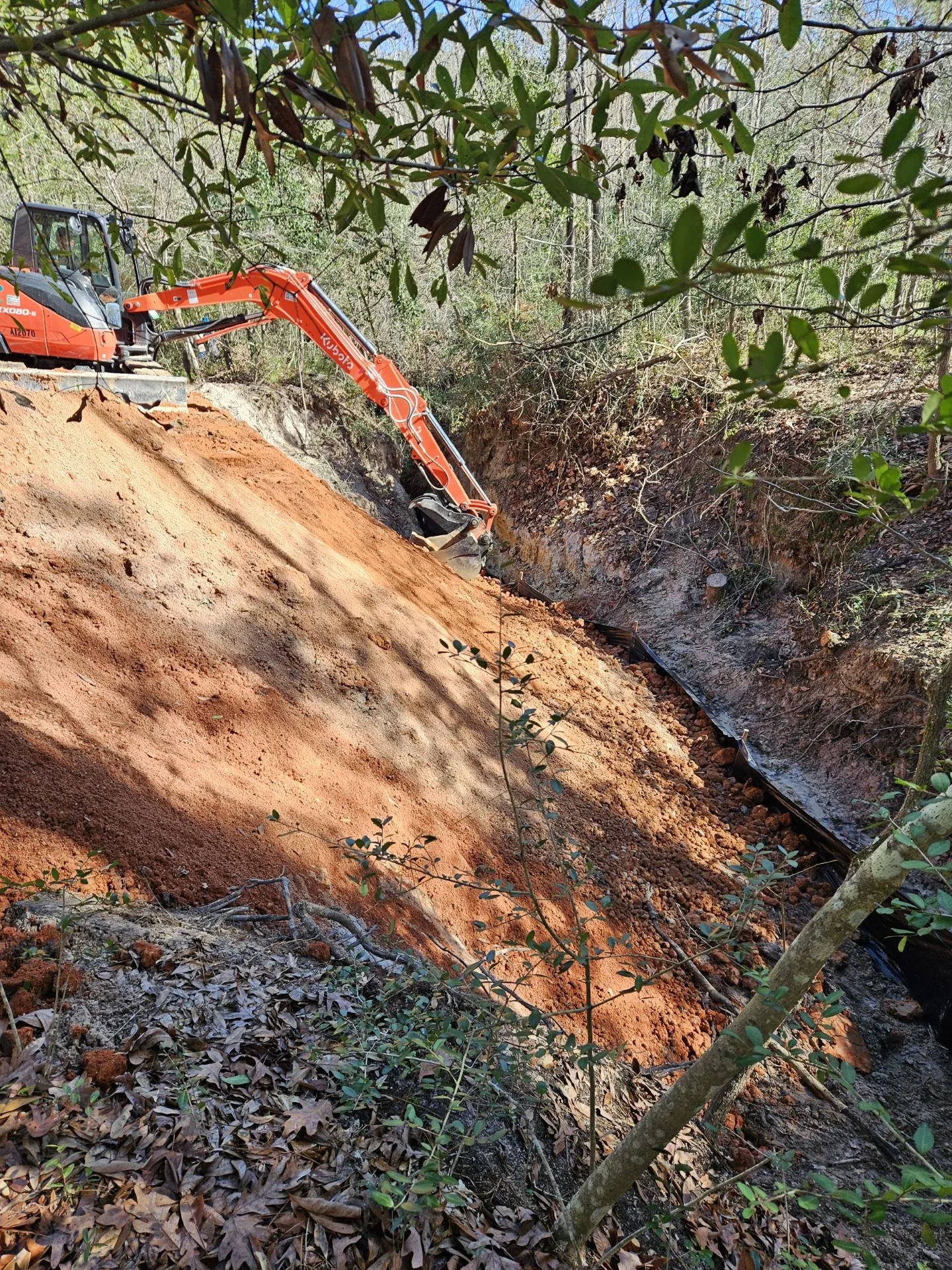
We grade the bank to a stable slope, then excavate a keyed toe trench at the base — the detail that locks the whole rock mass in place so it cannot slide or slump downhill.
-
Filter Fabric, Bedding & Stone Placement
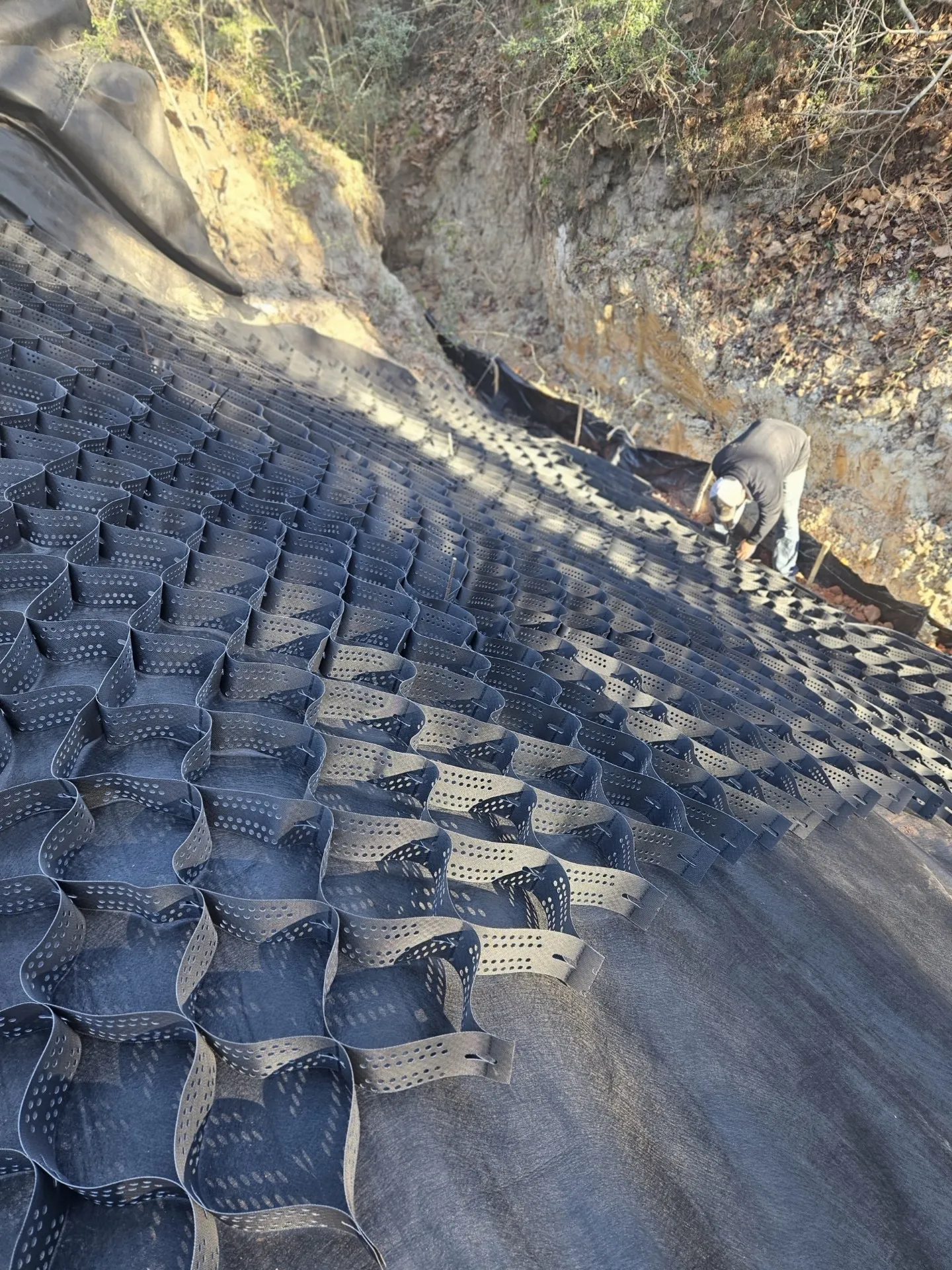
Non-woven filter fabric goes down with proper overlaps, then bedding stone, then graded armor stone placed from the toe upward so the section interlocks instead of segregating.
-
Transitions, Cleanup & Walkthrough
We tie the section into adjacent bulkheads, walls, or natural grade — the transition points where erosion loves to restart — then demobilize, clean up, and walk the finished bank with you with maintenance guidance.
Materials & Method
Riprap installations use properly graded armor stone over filter fabric and bedding stone, with an engineered toe so the section does not slump or wash out. Stone size is matched to the wave and current energy at your site.
Why Riprap Works: Engineering Disguised as a Pile of Rocks
Riprap succeeds by dissipating energy instead of resisting it. Where a vertical wall takes a wave's full force and reflects it back (often scouring its own toe in the process), a sloped riprap section breaks the wave across hundreds of irregular stone faces, converting its energy to turbulence within the voids. The result is a shoreline defense that gets more stable as it settles, needs no anchoring system, and shrugs off the freeze-free Gulf Coast weathering that degrades other materials.
But the 'pile of rocks' impression hides real engineering, and skipping it is why amateur riprap slides into the lake within a few seasons. Stone must be sized to the wave and current energy at the site — undersized rock simply washes away. The section needs a proper toe, keyed at the base of the slope, so the armor can't slump downhill. And critically, filter fabric and bedding between stone and soil keep the bank from washing out through the voids — the invisible layer that separates permanent installations from temporary ones.
We design and build the full section: slope preparation, filter fabric and bedding, engineered toe detail, and graded armor stone placed to the design — then tie the edges into adjacent bulkheads, walls, or natural grade so the transition points (where erosion loves to restart) are closed.
Where Riprap Is the Right Answer on Texas Water
Riprap shines on sloped shorelines with moderate wave and wake exposure — the classic Lake Conroe and Lake Livingston bank — where it stops erosion, looks natural against a wooded lot, and typically costs less than a driven wall. It's equally at home armoring bayou banks against current, protecting culvert and outfall ends, and defending the long shorelines of HOA commons and lake communities where per-foot economics matter.
It also works in combination: placed at the toe of a bulkhead or seawall, riprap absorbs wave energy before it reaches the wall and prevents the toe scour that undermines vertical structures — a pairing we recommend often on exposed runs. On very steep or vertical banks, or where yard space can't be given to a slope, a bulkhead is the honest recommendation instead, and we'll tell you so.
Shoreline armoring below the waterline generally requires approval from the controlling authority — SJRA, TRA, City of Houston, or USACE/GLO depending on your water — which we handle as part of every installation. What you get is a finished, permitted section built to hold: stone sized to your site's energy, on fabric, with a keyed toe, tied cleanly into whatever borders it.
Stone Sizing, Gradation, and the Standards Behind a Section That Holds
Riprap that lasts is built to a specification, not to whatever the quarry had loaded. The reference standard in Texas is TxDOT Item 432, which defines the gradations we work to: Type R protection stone runs 50 to 250 pounds per stone with at least half the stones heavier than 100 pounds, so the mass interlocks under wave attack instead of rearranging with every storm. Under the stone goes non-woven filter fabric per TxDOT DMS-6200 — placed with its long axis running up the slope and a minimum two-foot overlap between sheets — which is the invisible layer that keeps your bank from washing out through the voids.
Sizing follows the water, not a price list. A sheltered Lake Conroe cove tolerates smaller graded stone; a long-fetch Conroe or Livingston shoreline that takes weekend wake all summer needs heavier rock; and open bay edges on Clear Lake and Galveston Bay demand the largest sections with crest elevations set for boat wake and surge. Stone type is chosen the same way — durable limestone or granite where energy and salinity demand it, and (where the authority allows) recycled crushed concrete as an economical option on protected banks.
Placement order is part of the engineering: slope graded and compacted first, toe key excavated, fabric and bedding down, then armor placed from the toe upward so the section interlocks rather than segregating. We finish by chinking with spalls where the design calls for it and photographing the completed section — so you, your HOA, or your inspector can see exactly what's under the waterline.
Outfalls, Toe Aprons, and Banks You Can Only Reach by Water
Not all riprap is a shoreline revetment. Culvert and outfall ends are among the most erosion-prone points on any property or subdivision — concentrated discharge digs a scour hole, the hole becomes a headcut, and the headcut marches upstream toward whatever the pipe runs under. A correctly sized riprap apron at the outlet spreads and slows that discharge before it can cut. We build aprons for residential drainage, HOA detention and channel outfalls, and private crossings, sized to the pipe and flow rather than guessed.
The second specialty is toe protection for existing structures. A riprap apron placed at the base of a bulkhead or seawall absorbs wave energy before it reaches the wall and stops the toe scour that undermines vertical structures from below — frequently the single best-value upgrade on an exposed wall, and a standard component of our seawall repair work. We also rehabilitate legacy riprap that has slumped or gone hollow: rebuilding the toe, adding the filter layer the original installer skipped, and topping up displaced stone costs a fraction of starting over.
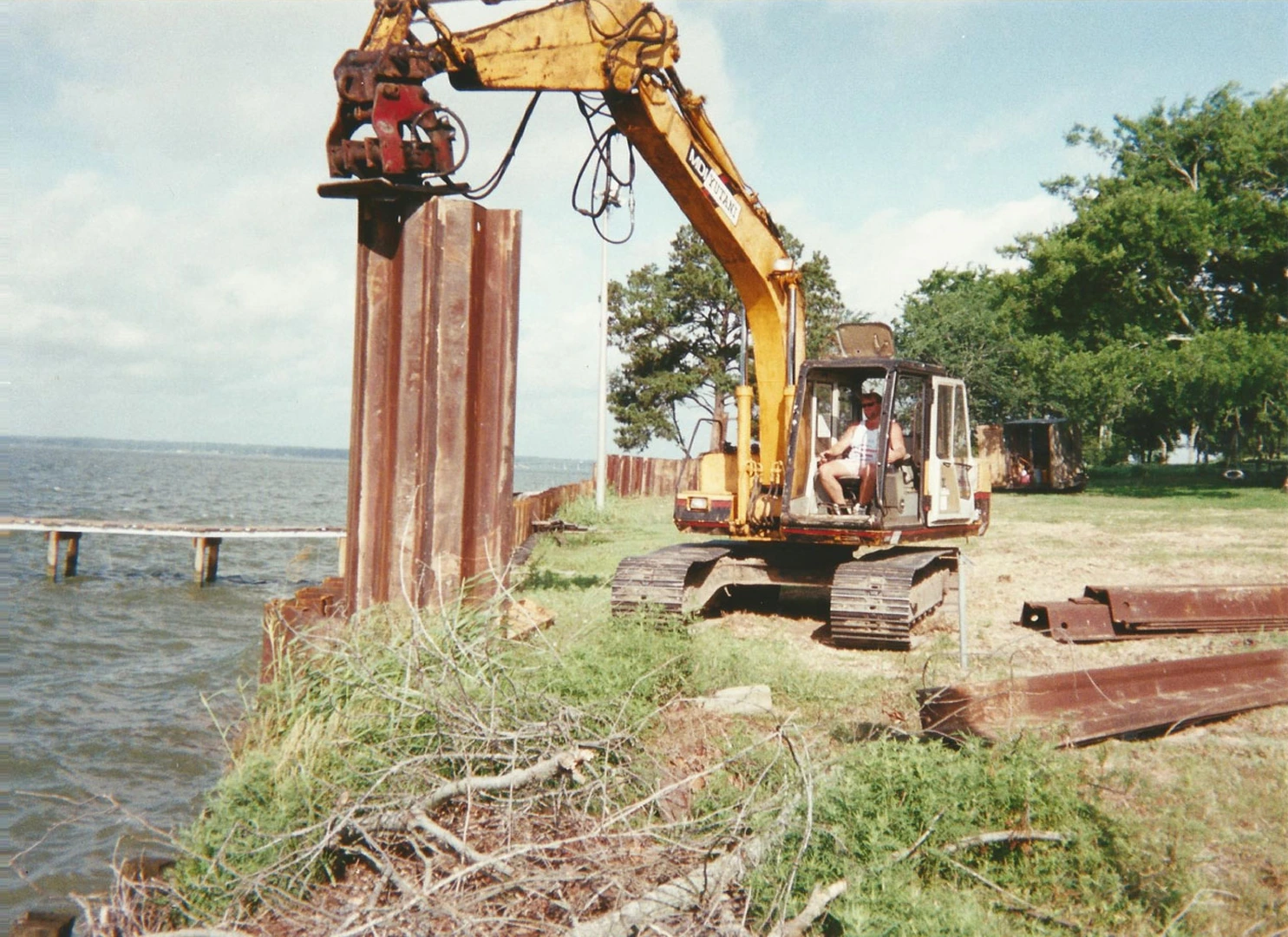
Access rarely stops the work. Where a bank has no land route — dense lots, finished landscaping, canal frontage — our barge-mounted equipment places stone from the water, the same capability we use for pile driving and bulkhead work across Lake Conroe, Lake Livingston, and the bay. Tight sites get planned staging so the yard you're protecting isn't sacrificed to protect it.
Standards & Permits Riprap Is Built To
Riprap looks simple from the bank, but a section that survives Texas storm seasons is built to published standards — stone gradation, filter fabric, toe embedment — and permitted through the authority that controls your water. These are the specifications we design and place to, with citations.
Stone, Filter Fabric & Section — TxDOT Standard Specifications, Item 432
The Texas Department of Transportation's Item 432 (Riprap) is the reference specification for protection stone in our region. We size, grade, and place armor to it:
- Type R Protection stone riprap graded 50–250 lb per stone, with at least 50% of stones heavier than 100 lb (Type F: at least 40% over 100 lb) — so the mass interlocks under wave attack.
- DMS-6200 Type 2 non-woven filter fabric beneath protection riprap, placed with its long axis up the slope and a minimum 2 ft overlap between adjacent sheets — the layer that keeps bank soil from washing out through the stone voids.
- Item 432 Stone placed from the keyed toe upward to the specified section thickness, interlocked rather than dumped, with edges tied into adjacent structures or grade.
Permits — USACE Nationwide Permit 13 & Local Authorities
On Lake Conroe, riprap and shoreline work are licensed through the San Jacinto River Authority; Lake Livingston runs through the TRA and Lake Houston through the City of Houston. On navigable and coastal waters, bank stabilization is permitted by the USACE Galveston District — most residential projects under Nationwide Permit 13:
- NWP 13 Bank stabilization up to 500 ft along the bank and no more than an average of 1 cubic yard per running foot below the ordinary high-water mark qualifies for the nationwide permit; longer or heavier sections require pre-construction notification to the district engineer.
Sources & Official References
Specifications above are summarized from the referenced standards as of July 2026 and are provided for planning. Every installation is designed and permitted to the current requirements of the authority having jurisdiction.
Related Projects
Where We Build Riprap Installation
We build riprap installation for waterfront communities across Greater Houston, Lake Conroe, Lake Livingston, and the Texas Gulf Coast. A few of the areas we serve:
Don't see your area? View all service areas or contact us.
Riprap Installation FAQs
Is riprap cheaper than a bulkhead?
On suitable shorelines riprap can be a cost-effective, natural-looking option. On vertical or high-energy shorelines a bulkhead or seawall may be required. We will recommend the right approach for your bank.
Can riprap be combined with a bulkhead?
Yes. Riprap is often placed at the toe of a bulkhead or seawall to absorb wave energy and protect the foundation.
How much does riprap installation cost?
Cost scales with shoreline length, section size (which follows bank height and slope), stone size required by your site's wave energy, and access for placing equipment. On suitable banks it's frequently the most economical permanent armor per foot. Free assessments and itemized estimates make the comparison against a wall straightforward.
What size rock is used for shoreline riprap?
Whatever the site's energy dictates — sheltered coves tolerate smaller graded stone, while long-fetch and high-wake exposures demand heavier rock that waves can't shift. Sizing stone to real conditions is the core engineering decision; undersized rock is the most common failure in DIY installations.
Does riprap need maintenance?
Very little. A properly built section — sized stone, filter fabric, keyed toe — settles into increasing stability. Worth checking after major storms: displaced stones at the edges and any soil appearing between rocks (a sign the filter layer was compromised). Both are inexpensive to address early.
Will riprap attract snakes or pests?
Stone voids provide habitat the way any natural shoreline feature does — no more than the vegetated or timber alternatives. Keeping the section free of brush and debris minimizes it. For most owners the trade against a permanently stabilized, natural-looking bank is easily worth it.
Can you install riprap where my bulkhead used to be?
Often yes — a failed bulkhead can be removed (or cut down) and the bank regraded to a stable slope for riprap, which sometimes costs less than wall replacement and permits more naturally. Feasibility depends on bank height, lot space for the slope, and the authority's rules; we evaluate it during assessment.
Do I need a permit to install riprap?
Usually yes, because the stone goes below the waterline. On Lake Conroe the SJRA licenses shoreline work, Lake Livingston runs through the TRA, Lake Houston through the City of Houston, and coastal or navigable waters through the USACE Galveston District and Texas GLO. Many bank-stabilization projects qualify under USACE Nationwide Permit 13 — up to 500 feet of bank and one cubic yard per running foot below the ordinary high-water mark — and larger sections need pre-construction notification. We prepare and coordinate whichever applies.
How long does riprap installation take?
Once permits are in hand and stone is delivered, most residential shorelines take a few working days — the section length, bank height, and access set the schedule. Barge-placed and long HOA runs take proportionally longer. We give you a written timeline with the estimate and stage the work so your yard is disturbed once, not repeatedly.
What type of stone do you use — limestone, granite, or concrete?
The site decides. Durable limestone and granite are the standards where wave energy or brackish water demand it; clean recycled crushed concrete can be an economical option on protected banks where the controlling authority allows it. Gradation matters more than rock type — we size and grade stone to your site's energy per TxDOT Item 432 so the mass interlocks and stays put.
Can riprap fix the erosion at my culvert or drainage outfall?
Yes — that's one of its best uses. Concentrated discharge scours a hole at the outlet and starts a headcut that migrates upstream. A properly sized stone apron over filter fabric spreads and slows the flow before it can cut. We size aprons to the pipe and flow for homes, HOAs, and private crossings.
Related Services
Get a Free Riprap Installation Estimate
Tell us about your project and we'll provide a detailed, no-obligation estimate. Serving Greater Houston, Lake Conroe, Lake Livingston, and the Texas Gulf Coast.