

A new seawall is the most effective long-term defense against shoreline erosion, wave action, and soil loss. Jordan Marine Construction designs and builds engineered seawalls across Greater Houston, Lake Conroe, Lake Livingston, Clear Lake, and the Texas Gulf Coast for residential, HOA, lake-community, and commercial waterfronts.
We build in steel, vinyl, and treated timber, and engineer every wall for the soil, water depth, retained height, and wave exposure of your specific site. From design and permitting through pile driving, wall installation, tie-backs, and backfill, we deliver a finished, protected shoreline.
Request Your Free EstimateOur Seawall Construction Process
-
Shoreline & Soil Assessment
We evaluate bank height, soil type, water depth, and wave exposure to engineer the right wall and material.
-
Engineered Design & Permitting
We specify the sheet material, embedment, whalers, and tie-back system, and coordinate permitting with the controlling authority.
-
Driving & Wall Installation
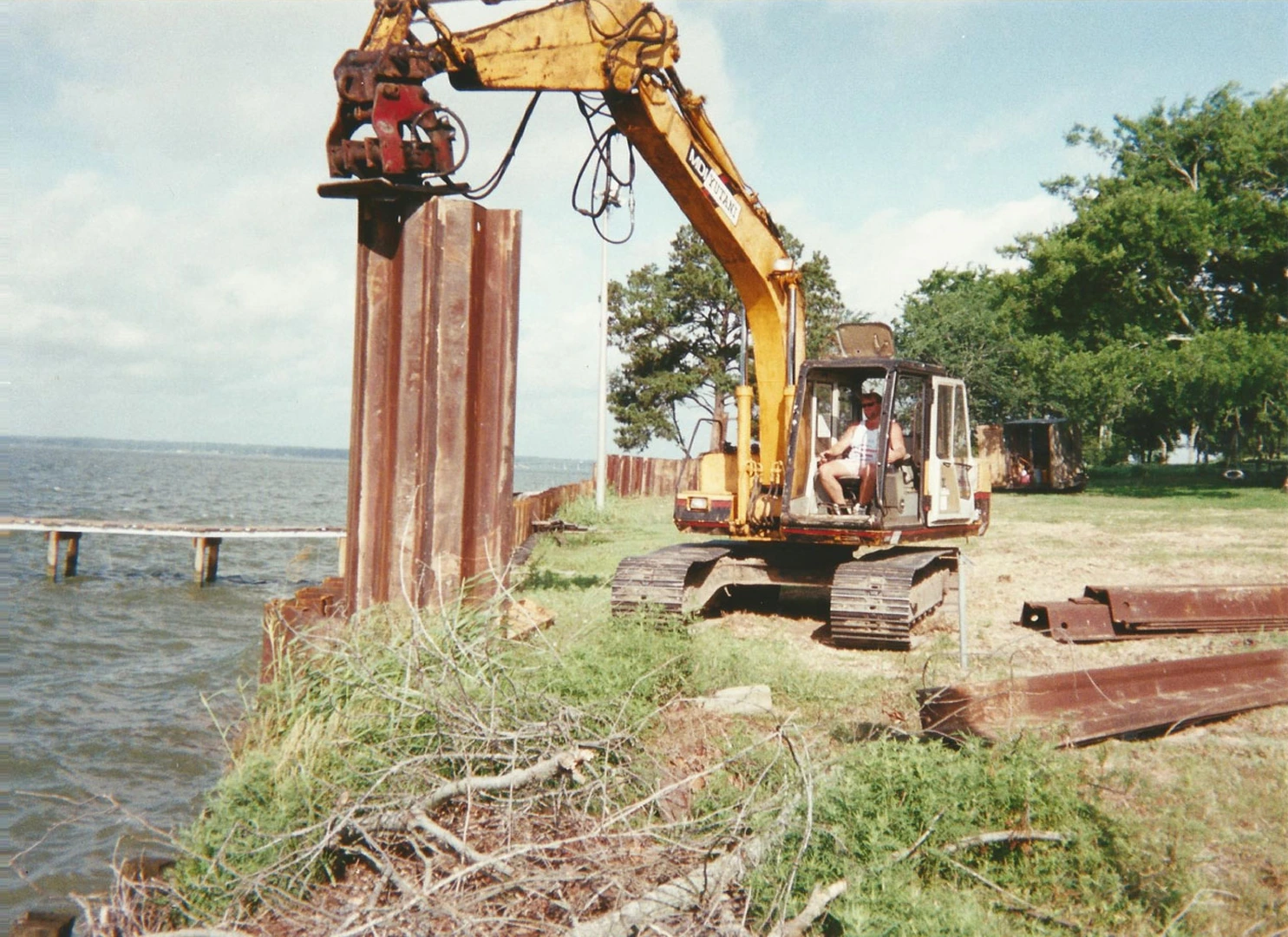
We drive sheeting to the engineered depth and install structural whalers and tie-back anchors for a rigid, lasting wall.
-
Backfill & Restoration
We backfill, compact, and restore grade and sod behind the new seawall.
Materials & Engineering
We build seawalls in steel sheet piling for maximum strength, vinyl for a corrosion-proof low-maintenance wall, and treated timber for traditional appeal. Every wall is engineered for the retained soil height and hydrostatic loads at your site, with hot-dip galvanized or composite hardware and proper drainage to prevent the pressure buildup that causes failures.
A New Seawall Is an Engineering Project Before It's a Construction Project
Two seawalls can look identical from the water and have completely different lifespans, because everything that determines a wall's fate is invisible when it's finished: how deep the sheets are embedded below the mudline, how the tie-back system is anchored, whether drainage relieves the water pressure behind the wall, and whether the material matches the water chemistry. We engineer all of it to your specific site before a single sheet is driven.
The design inputs are physical facts about your shoreline: retained soil height, soil type and its behavior when saturated, water depth at the wall line, wave and wake exposure across the fetch, and what stands behind the wall — lawn, patio, pool, or foundation. From those we specify sheet material and section, embedment depth, whaler sizing, tie-back rod and deadman layout, and the drainage detailing that most cheap walls skip and most failed walls lack.
Because we run our own pile-driving and driving equipment, the engineering translates directly into the ground: sheets driven to the designed depth, anchors set where the plan puts them, and backfill compacted in lifts rather than dumped. The contractor who designs the wall and drives it carries accountability for both.
Steel, Vinyl, or Timber: Matching the Wall to the Water
Steel sheet piling is the strength benchmark — the choice for tall retained heights, high-energy and commercial shorelines, and walls where failure consequences are severe. Modern coatings and appropriate section thickness manage corrosion even in brackish exposure, and on freshwater lakes steel lasts extraordinarily long.
Vinyl sheet piling has become the residential standard on Lake Conroe and Lake Livingston for good reason: it cannot rust, rot, or be attacked by marine borers, holds its appearance for decades, and costs meaningfully less than steel at the moderate wall heights most lake lots need. Treated timber remains the traditional, budget-friendly option — .60 CCA retention for freshwater, 2.5 CCA where water turns brackish — and builds a handsome wall when detailed with through-bolted galvanized hardware.
We build all three systems, which keeps our recommendation honest: the material follows your site's physics and your budget, not our inventory. On many projects the smart answer is a combination — a vinyl wall with riprap at the toe to absorb wave energy, or steel on the exposed run and vinyl in the protected cove.
From Permit to Protected Shoreline: What the Project Looks Like
Every new seawall in our region needs a permit from its controlling authority: the San Jacinto River Authority on Lake Conroe, the Trinity River Authority on Lake Livingston, the City of Houston on Lake Houston, and the USACE Galveston District with the Texas General Land Office on coastal waters. We prepare the drawings and applications and manage the review — a process we run constantly and know how to keep moving.
Construction proceeds in a disciplined sequence: demolition or bypass of any existing wall, sheet driving to engineered depth, whaler and tie-back installation, drainage detailing, then backfill placed and compacted in lifts. We finish with grade restoration and sod so you get back a completed shoreline, not a construction site. Where an old wall exists, we can often drive the new wall just waterward of it — avoiding excavation of your yard entirely.
The finished wall protects more than the dirt behind it. A sound seawall stabilizes everything that depends on that soil — foundations, pools, septic systems, mature trees, docks tied into the bank — and it's one of the few site improvements that appraisers, buyers, and insurers all read as direct risk reduction.
Related Projects

Where We Build Seawall Construction
We build seawall construction for waterfront communities across Greater Houston, Lake Conroe, Lake Livingston, and the Texas Gulf Coast. A few of the areas we serve:
Don't see your area? View all service areas or contact us.
Seawall Construction FAQs
Which seawall material is best — steel, vinyl, or wood?
Steel offers maximum strength for tall walls and high-energy shorelines; vinyl is corrosion-proof and low maintenance; timber is cost-effective with traditional appeal. We recommend the right material after assessing your site conditions and budget.
Do you handle seawall permitting?
Yes. We coordinate permitting with the relevant authority — SJRA on Lake Conroe, the City of Houston on Lake Houston, and USACE Galveston District / Texas GLO on the coast.
How long does a new seawall last?
A properly engineered and installed seawall lasts for decades. Material choice, drainage, and tie-back design all affect longevity, all of which we specify correctly for your site.
How much does a new seawall cost per foot?
Per-foot cost varies with material (timber lowest, vinyl mid, steel highest), wall height and embedment, tie-back requirements, demolition of an existing wall, and site access. Because those variables swing widely between properties, we price from a site assessment — free and itemized so you can compare materials directly.
How long does seawall construction take?
Typical residential walls run from several days to a few weeks of construction once permits clear, depending on length, material, and access. Permitting timelines vary by authority — SJRA, TRA, City of Houston, or USACE/GLO — and we manage that process to keep it moving.
Can you build a new seawall in front of my old one?
Often yes, and it's frequently the best approach: the new wall is driven just waterward of the failing one, tied back over it, and the gap filled — sparing your yard the excavation of a full removal. Whether it's feasible depends on the authority's rules and your lot line at the water; we confirm during assessment.
How high should my seawall be?
Cap height is set from observed high-water behavior, wave run-up, and the authority's standards for your waterbody — not a universal number. Too low invites overtopping in storms; unnecessarily high adds cost. We design from the water-level history of your specific lake or bay.
Does a new seawall need maintenance?
Very little when built right, but not zero: keep an eye on drainage outlets, watch for settling behind the cap in the first seasons (minor settlement of new backfill is normal), and have the tie-back hardware inspected periodically as the wall ages. We build so the routine is inspection, not intervention.
Related Services
.webp)
Get a Free Seawall Construction Estimate
Tell us about your project and we'll provide a detailed, no-obligation estimate. Serving Greater Houston, Lake Conroe, Lake Livingston, and the Texas Gulf Coast.